20 September 2010

FTKMF Part 8- Journal


Timed Writing
Part 8
Loung refers to their escape to Thailand as part of the "human export operation" (page 216). Explain how she and Meng made it from Cambodia to America and your opinion of the process...... should it have been done differently so that the refugees were better cared for? Or was this the best (and only) way?

16 September 2010

FTKMF Part 7 Journal


Timed Writing
Part 7
Would you categorize the events in Part 7 as JUSTICE or REDEMPTION? Or both? Why?
Or like she says on page 206, "it is too late for my parents and my country." Was it too late for justice or redemption?

13 September 2010

FTKMF Part 6 Journal


Timed Writing
Part 6 (Chapters 18-21)
Describe the RESOURCEFULNESS of the 3 Ung children (Kim, Chou, Loung) after they are reunited again.


09 September 2010

FTKMF Part 5 Journal


Timed Writing
Part 5 (Chapters 14-17)

Describe the use (and power) of REVENGE in this section.


03 September 2010

AT8 REJSER

What are the motivations of people who travel (and people who do not).

What problems/disappointments/frustrations can travel cause?

What are the long-term effects of travel-- how does it impact our future and who we are as people? Does it change us? Does it change the location to which we travel?


An analysis of 6 films:

1. Crossing Over


2. Under the Tuscan Sun


3. Into the Wild


4. The Time Traveler's Wife


5. Titanic


6. The Holiday

02 September 2010

The Role of Media in our Lives

How much influence does the media have on our lives?


Do we, as the human race, have the power to block out what they are telling us and make our own decisions and choices?


Who is ultimately responsible for what the media "feeds" us?

Think about "messages" that the media has given you in the past about a story or a situation or a group of people. Have any of these messages ever angered you?
How far does a journalist go to "get a story"; or how far SHOULD he go to get a story?

And now the 6 million dollar questions:
SHOULD THE MEDIA EVER BE CENSORED?

What about this example of a regular radio broadcast in Rwanda prior to the genocide of 1994:
"You have to kill the Tutsis; they're cockroaches.
All those who are listening, rise so we can fight for our Rwanda. Fight with the weapons you have at your disposal: those who have arrows, use arrows. Those who have spears, use spears. We must all fight.
We must all fight the Tutsis. We must finish them, exterminate them, sweep them from the whole country. There must be no refuge for them.
They must be exterminated. There is no other way."

Your task for next class:
Bring in a news story (in Danish or English) that is somehow connected to HUMAN RIGHTS (can be a violation of or a preservation of). Read this article before class and be prepared to share the story with your group as it relates to these questions:
1. How does this article make you feel when you read it?
2. Do you think the reporter did a good job reporting the story from a human rights' perspective?
3. Why or why not?
4. Could this article have an influence (positive or negative) on the reader?

Here is an example... MOSQUE AT GROUND ZERO

FTKMF Part 4- Journal


Timed Writing
Part 4 (Chapters 10-13)
On page 108 Loung says, "My heart hardens at her words, knowing I cannot allow myself the luxury of hope. To hope is to let pieces of myself die."

How has this little girl changed since we first met her? How has survival, the mere fight to live, affected her?

30 August 2010

FTKMF Part 3 Journal


Timed Writing
Part 3 (Chapters 7-9)
Describe the Angkar's view of Capitalists and why the Western World was seen as such a threat. Was there any validity to their claims?

26 August 2010


Part 2 (Chapters 4-6)

Describe Loung's behavior in these chapters. Is her behavior that of a "typical spoiled five year old"?


23 August 2010

Journal- Part 1 FTKMF


Part 1 (Chapters 1-3)


Describe "Loung's Cambodia" as she presents it to us in the first two chapters.

20 August 2010

Options to Fight Genocide

Genocide exists.
It has existed for centuries.

Genocide as defined by the United Nations in 1948 means any of the following acts committed with intent to destroy, in whole or in part, a national ethnic, racial, or religious group, including:

• Killing members of the group;
• Causing serious bodily or mental harm to members of the group
• Deliberately inflicting on the group conditions of life calculated to bring about its physical destruction in whole or in part
• Imposing measures intended to prevent births within the group
• Forcibly transferring children of the group to another group

One would think that with the increase of knowledge about the world and its people that has occured since the beginning of the 20th century, genocide would not be as prevalent in today's contemporary society.

However, genocide plagued the world throughout the 20th century and we already have evidence of that pattern repeating itself today.


Are we not learning from our mistakes and the mistakes of our ancestors? Or do we just not care enough about the world OUTSIDE our own borders? You decide. HOW do we, as an INTERNATIONAL COMMUNITY, fight Genocide?
You have 4 options.


*Note: Option 4 refers to the US as we have seen that "as the US goes, so the world follows".

19 August 2010

What were The Killing Fields?

This film was released in 1984 and follows the story of an American journalist, Sydney Schanberg and Dith Pran, his Cambodian interpreter and fellow journalist. They have been working in the Cambodia, reporting the events of the civil war that was going on in the early 1970s. However, in 1975 everything changed.


On April 17, 1975, Cambodia's capital city, Phnom Penh, fell under the control of the Khmer Rouge, the communist guerilla group led by Pol Pot. They forced all city residents into the countryside and to labor camps. During the three years, eight months, and 20 days of Pol Pot’s rule, Cambodia faced its darkest days, an estimated 2 million Cambodians or 30% of the country’s population died by starvation, torture or execution. Almost every Cambodian family lost at least one relative during this gruesome holocaust.

________________________________________
Pol Pot's Year O

Pol Pot declared 'Year Zero' when Khmer Rouge captured Phnom Penh on April 17, 1975. He immediately directed a ruthless program to "purify" Cambodian society of capitalism, Western culture, religion and all foreign influences. He wanted to create Cambodia into an isolated and totally self-sufficient state. Anyone who opposed was killed. Foreigners were expelled, embassies closed, and the currency abolished. Markets, schools, newspapers, religious practices and private property were forbidden. The police, public servants, military officers, teachers, ethnic Vietnamese, Christian clergy, Muslim leaders, members of the Cham Muslim minority, members of the middle-class and the educated were identified and executed.

The country's entire population was forced to relocate to the agricultural labor camps, the so-called "killing fields". Inmates lived in primitive conditions. Families were separated. Former city residents were subjected to unending political indoctrination and brainwashing. Children were encouraged to spy on adults, including their parents.

An estimated 1.5 - 3 million worked or starved to death, died of disease or exposure, or were executed for committing crimes. These crimes which were punishable by death included: not working hard enough, complaining about living conditions, collecting or stealing food for personal consumption, wearing jewelry, engaging in sexual relations, grieving over the loss of relatives or friends and expressing religious sentiments

________________________________________

"We will be the first nation to create a completely Communist country without wasting our time on the intermediate steps." -Khmer Rouge Minister of Defense, Son Sen

"To spare you is no profit, to destroy you is no loss." -Khmer Rouge slogan


________________________________________

It is at this point we find Sydney Schanberg and Dith Pran. Sydney has been sent back to the United States, but his Cambodia colleague is forced to stay and sent to a work camp in the Killing Fields. Sydney is struggling to understand just who is responsible for these atrocities while his friend is struggling to stay alive.
________________________________________

An Introduction to "First They Killed my Father"

Watch the following photo story and answer these questions: What do you see? What do you know? What do you feel? What do you wonder?


The Cambodian Killing Fields lasted 3 years and 8 months and 20 days. But what were they? Who were the victims? And who were the guilty parties that caused them? All of these questions, as well as many others, will be answered as we follow the journey of Loung Ung in

16 August 2010

Question of Humanity

As we enter this study of "The Face(s) of Humanity", look at this picture recently released by the Dansk Folkeparti and share what you think about when you see this image.

20 May 2010

And Still I Rise....

What connections can you make between the Lorraine Hansberry's A Raisin in the Sun and this poem by Maya Angelou?

03 May 2010

Ending Jim Crow?

Once African Americans were given the right to vote (1870), less than 5% of them actually exercised that right because southern states set up literacy tests that had to be passed in order to vote. For the white man, these tests were not a problem, but for a black man or woman these tests were a huge barrier. After years and years of slavery followed by years of inequity in education and schooling, many blacks did not know how to read or write. This helped the white man ensure that although the black man had the right to vote, he would never be able to act on it.....

Because of these situations throughout the south, many Civil Rights' activists were determined to make a change. They set up voting clinics throughout the south where they worked with African Americans, helping them to pass the literacy tests and become officially registered to vote. Their efforts were met with violent repression from state and local lawmen, White Citizens' Council, and Ku Klux Klan resulting in beatings, hundreds of arrests and the murder of several voting activists as seen in this clip from the film "Mississippi Burning".


After watching this clip, discuss in your groups how it is possible to have laws on paper that are not enforced in practice. What examples of hypocrisy do we see in government and policy in the 1960s and still today? How can this double standard be stopped? Or can it be?

27 April 2010

Raisin in the Sun...and the Jim Crow South


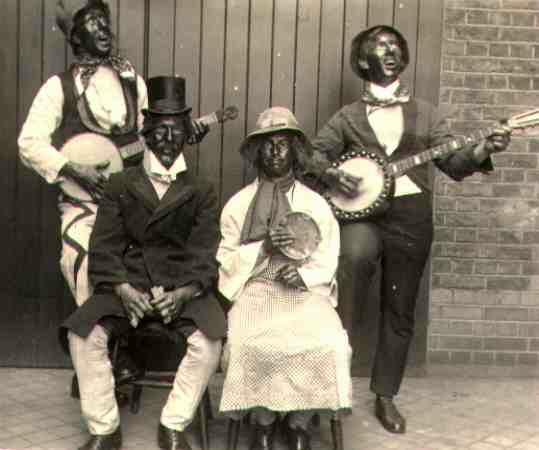
It is important to understand what was happening in the US at the time that A Raisin in the Sun is set and the place to start the understanding is finding out... WHO WAS JIM CROW?

Describe this picture of "Jim Crow" and discuss in your group how you feel when you look at it. Are the feelings positive, negative, happy, entertaining, degrading, or something else? Why?


If you were to learn that this image represents a white man dressed up with black paint on his face, meant to mimic the black man, does that change your thoughts about the image at all?

A little background information:
The minstrel show was an American entertainment consisting of comic skits, variety acts, dancing, and music, performed by white people in blackface. Minstrel shows lampooned black people in mostly disparaging ways: as ignorant, lazy, buffoonish, superstitious, and musical. The minstrel show began with brief burlesques and comic acts in the early 1830s and emerged as a full-fledged form in the next decade.


Watch 2 examples of an old Minstrel skit.
As you watch it, think about the following items:
1. Is this type of entertainment appropriate or not?
2. What is the message behind this type of entertainment?
3. Should it have been allowed?
4. What was its purpose?
5. How did it make you feel as you watched it?
6. And finally..... would you have felt differently if you were an African American watching this?


Now look at the following images associated with "Minstrel entertainment".

Are these images examples of FREEDOM OF SPEECH or are they examples of BIGOTRY?


How far does FREE SPEECH "cover" you?


Or are there consequences of our exercising our Freedom of Speech? What are the consequences of things like the MINSTREL SHOWS and these ads?

And what about the consequences of this example of FREEDOM OF SPEECH? Should there be a "limit" to our freedom of speech?


19 April 2010

A Raisin in the Sun

The Civil War in the United States was fought from 1861-1865.
In 1863 President Abraham Lincoln signed the


which formally abolished slavery in the United States and declared all men free when it said:

"That on the 1st day of January, A.D. 1863, all persons held as slaves within any State or designated part of a State the people whereof shall then be in rebellion against the United States shall be then, thenceforward, and forever free...."


So how is it possible that ONE HUNDRED YEARS LATER, the Jim Crow Laws could still be in effect?

Your group's task:
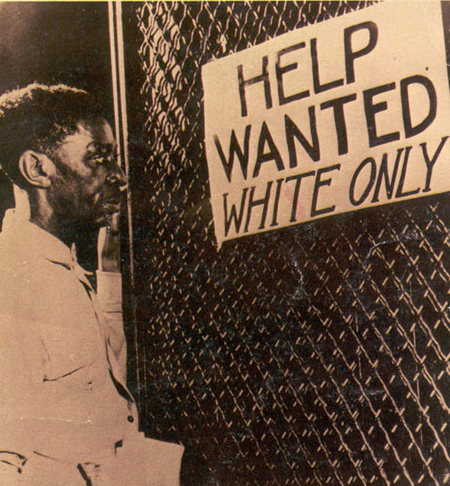
Look at each of the following pictures which are examples of Jim Crow Laws throughout the southern United States in the 20th century.
How do they make you feel?
What do they make you want to do/say when you see them?


What about statements such as these about Jim Crow Laws:
1. One rationale for the systematic exclusion of Black Americans from southern public society was that it was for their own protection.....
2. Allowing Blacks in White schools would mean constantly subjecting them to adverse feelings and opinions which would not be fair for them to experience....

How do these make you feel when you hear them? What could members of society do to actually change these opinions, these laws, and these ways of thinking?!!? Could they do anything?


Sure....they could move NORTH because things must be better there, right?!

15 April 2010

A Final Reflection on GOW

We heard former first lady, Eleanor Roosevelt's thoughts about GOW the day we began this journey with the Joads.

"The Grapes of Wrath, by John Steinbeck, both repels and attracts you. The horrors of the picture, so well drawn, make you dread sometimes to begin the next chapter, and yet you cannot lay the book down or even skip a page. The book is coarse in spots, but life is coarse in spots, and the story is very beautiful in spots just as life is...Even from life's sorrows some good must come. What could be a better illustration than the closing chapter of this book?" ~ Eleanor Roosevelt, 1939

Along that same vein about the effect The Grapes of Wrath should have on its readers, John Steinbeck wrote to his editor:


"I've done my damndest to rip a reader's nerves to rags.
I don't want him satisfied."


Did he succeed in doing that to you?
If so, how did he accomplish it?
If not, why weren't you affected in that way?

and what more appropriate music to wrap up our study than one more tune from The Boss.....


17 March 2010

Quote Analysis

In preparation for GOW Writing assignment #2, today's journal is a quote analysis from part 1 of the novel. Your task is to analyse this quote for its literal/figurative meaning, the message it has (who said it, why he said it, what the context was for the quote, etc)for the story as a whole, and Steinbeck's intention in writing it.


"This here is my country. I b'long here. An' I don't give a goddamn if they's
oranges an' grapes crowdin' a fella outa bed even. I ain't a−goin."
--Granpa, Chapter 10, pg. 143